I saw it happen with my eyes open.
The windshield shattered, a woman cupped your head, the gasoline bleeding from the wounded car. They strapped you into an ambulance, hooked you up to a tangle of clear tubing. I let Frank take the call when it came, hours later, let him book the first flight out.
The doctors at the trauma unit spoke of brain hemorrhage, ongoing procedures that made access to you inadvisable. They refused to grant visitation rights. Frank argued, his outrage at once articulate and patronizing, but the doctors merely grew more recalcitrant. Outside a pair of gaunt-faced policemen waited, notepads drawn. The policemen, in broken English, described the crash. You drove the car through a parco publico, rammed it into an ancient oak tree. You were sober. They looked at us, expecting us to provide clues to an accident that had occurred an ocean away, while Frank and I had slept. That is, Frank had slept. I had crouched in the bathroom, staring down sleep, retching as the procession of images intensified. The way I had done as a child.
The officers confronted us with the photograph of a woman, your colleague, they said. She was seen with you, moments before you tore through the park, in what the officers now suggested was an intentional attempt to kill. An intent to kill yourself, not others, they clarified. The picture showed a woman who was the opposite of death, red-cheeked, lush-haired, made of solid flesh.
How could you not have mentioned her? You, who always tell me everything?
I examined the photo, much like Frank examined his dead, pinned butterflies. She looked immaculate, this woman, her skin a fluorescent white, her face narrow and slightly off in its proportions, the eyes like liquid glass, the lips two pink threads. She looked older than you. Staring at her face, I felt a sharp pricking invade my skin, the sting of a thousand needles. The photograph slipped from my hand. One of the officers bent to pick it up, silently held it out to me. I didn’t look at it, didn’t touch it.
“I want to meet this woman,” I said.
I sensed it right away, I was asking for something illicit. The officer, short, with shrewd eyes, studied my insomnia-wrecked face. Ignoring Frank’s presence, he leaned in, unreasonably close.
“Be careful," he whispered, his breath warm and nicotined.
I am absolutely sure of this, but when I told Frank he insisted I was wrong, I had misheard. The officer, he said, had merely said: “It’s dreadful.”
Frank lacked even a shred of superstition, but I married him anyway, over my family’s objections, proud of how unsuitable they thought him. Frank was light to my family’s crypt, reason to their paranoia, sanity to their sickness. I was smitten with Frank.
A man of cool manners, but with sufficient reserves of feeling to appreciate beauty, to marry, to produce offspring. He closed bathroom doors, knocked before entering, shared what was necessary, but never more, mindful of emotional waste. You and I, we admired him. In the beginning, Frank’s spartan ways had soothed me. I had stepped from the loud, crowded market of my family into an empty, sunlit room. I made myself at home, and Frank accepted my presence.
But years later I understood that this was all there was, this was all the room would ever be. Empty and sunlit.
My emotional transparency exhausted Frank, and when I attempted to extract more a process of retreat clicked into motion. It was barely distinguishable, at first, from his calibrated detachment toward others; toward us, his wife, his son. It was not that Frank didn’t care, but that he offered care only within a limited temperature range. Even had he wanted to, he wasn’t equipped to be more than lukewarm.
I suffered the first time he expressed disdain, the first time I understood my love as an irritant. I took refuge in you, your warmth, your unfiltered need for me. I shielded you from your father’s unavailability, what you came to call his refractoriness. You once diagnosed our love as too intense a stimulation for him, it paralyzed his ability to function. It was your attempt to shield me. You who sat peering at shadows at night, fighting off sleep, like me. You kept calling, confiding in me night after night, long after moving out, your sleeplessness mirroring mine.
Now, deprived of you, I went numb. Cauterized.
But Frank seamlessly strung together a thousand explanations, all reasonable, all building up to the latent accusation that I had pushed you to do this, that if you had fled an ocean away and kept secrets, it was to escape the burden of being my son.
We met her at the museum, a former monastery studded with ancient, barred windows. You had worked here, in this severe building, its main gate a short walk from the scene of the accident. In the foyer hung a glistening painting, two infants with wizened faces, one naked and holding a snake-draped staff, his tiny foot propped on a human skull. Two fingers raised in a blessing.
“Christ triumphing over death and sin,” a female voice announced, and then she appeared in the shaft of light bisecting the lobby. Her hair and dress shone a tarry black, her skin gleamed chalk-white. The dress drew my eyes, made of delicate scales, from which a faint, ceaseless rustle emanated. A strip of cream fabric adorned the short puff sleeves, and on the hem of the skirt large blue dots stared out like unblinking eyes.
“Cayetana,” she said, and extended a veinless hand, the tips sharpened by ruby nails.
We followed her through a row of vaulted corridors, down a winding marble stair to your basement office. An airless closet stacked with filing cabinets, the only window at the back covered up with cardboard.
Frank reached for my hand, enclosed it, and I was transported back to the lucid calm of our first years. Together we explored your realm, touched the slanted desk, your chair, the papers and brushes and pencils you held every day. The stone walls released a hissing cold, but Frank’s hand was warm, his skin a more insulating organ than mine.
I glanced at Cayetana, motionless in the doorway, her exposed arms and neck aglow, as if lit by an inner furnace. She smiled at me, the blank smile of saints. Frank, by profession concerned with details, asked questions, intent on uncovering facts about you, about your mental state. He seemed not to notice the way Cayetana stared at him, her predatory immobility, her eyes sharp as fangs. Beneath their voices, I detected a dry, multiplying sound, like small bones snapping. I nudged Frank. I tried to speak to him, to warn him, but my tongue lay inert in my mouth, and instead of my voice, Cayetana’s filled my head:
“Cosimo worked here for a year,” she said. “Every day he came here, spent his days restoring, cleaning—” Her eyes met mine and a soundless spasm came over her body, the grey of her iris dissolved into the white of her eyeballs, the black pupils contracting to pinpoints“—bringing things back to life,” she slurred.
I staggered backwards, let go of Frank’s hand.
“Did you work with him?” Frank asked, oblivious. He was studying a note taped to your desk.
Cayetana wheezed, her white skin fading to gauzy blue, exposing the web of muscle, nerves and veins shimmering beneath. I felt the same vicious stinging seize my skin, needles lancing my neck, my scalp, driving tears into my eyes.
I groped blindly for Frank. “What is it?” he frowned.
“Dizzy,” I said, squinting.
Frank steadied my face with one hand, examined my eyes, raised one eyelid then the other. His touch was delicate and muted the pain. When we first met, I had mistaken the quality of his touch for tenderness, believed it reserved for me. I knew better now. I recognized the acquired skill, the technique in it. It was the delicate pressure required to stun butterflies, the calibrated pinch of the thorax between thumb and forefinger that left the insect defenseless.
“There is nothing wrong with your eyes,” Frank said. “Let’s get you some fresh air.”
He led me away by the elbow, but I could feel the creature at my side, its slim fingers clamping my wrist, the burn of them like ice pressed to skin. Back in the foyer, the hand released its grip and, from the corner of my eye, I caught Cayetana’s figure receding into the corridor of damp, mute bricks.
Out on the sidewalk, I inhaled the daylight while the furious needles eased their nasty work and finally ceased. Frank offered comfort, he believed I was crying for you. I wanted to tell him that Cayetana was not a woman, that she was a creature who feasted on our pain. Frank, I knew, was pragmatic about what he called my superstitions, made it a point of letting me share my thoughts, then offered words of appeasement. Yes, how strange, or: I am sure it seemed that way.
After which he felt he had done his duty, had earned the right to shelve the subject.
My family despised Frank. They saw themselves as spiritual vessels, and they saw Frank as the static scrambling their message. They were specialists too, but their expertise was in things unexplained, omens, miracles, faith.
He is offering a deal, they whispered.
Because in our family, evil was a slick merchant, always peddling a deal. They said Satan was misunderstood, a victim of his ambition. It was a matter of not upsetting him, of following the rules. From early childhood, I was warned not to speak his name.
When I first met Frank, he demanded evidence of my conversion. Because loving Frank was my conversion. He dared me to speak all his names aloud: Beelzebub, Mephistopheles, Lucifer. But at night, I still didn’t sleep. When you were born, we argued about you in daylight, tedious, verbal clashes. I wished for you to be like Frank, impervious, self-sufficient. But I couldn’t help worrying that no one was teaching you how to keep evil at bay. We were leaving you too exposed, an easy prey. Frank would brush it off.
“Nonsense,” he said. “Evil is lack of discipline.”
This is what I did as a child, when they left me alone in our railroad apartment on the third floor. Instead of switching on the lights, so I could see, I would leave all the lights off, so he could not see me. I would cower, wrapped in a woolen blanket, under the kitchen table, sweating with the effort of not moving, not screaming. And when my mother and grandmother and my uncle returned, and called out my name, Rebecca, like a kiss breaking a spell, I would throw off the blanket, flip on the kitchen light, scramble onto a chair, and pretend I had been there, drawing at the kitchen table, all along. But they always greeted me with a knowing smile, my mother murmuring words of comfort, my grandmother gently wiping my face dry.
“Nonsense,” Frank said. “He is just afraid of the dark. All children are.”
We retreated to our hotel room, all accent-lighted beige tones. Frank took out his equipment, the box of dead butterflies, and set to doctoring a new specimen, inspecting its thorax before puncturing it with a pin. I lay still on the double bed, studying him. The strong back, the face glazed with concentration. This ability he had of compartmentalizing pain. His absorption vexed me. I felt a brutal urge to shatter it, because it excluded me. It excluded you.
“Why did she say that,” I said, sitting up. “He brings things back to life?”
“Did she say that? It’s a manner of speech.”
“What do you mean, did she say that? You were there. She said it right in front of you.”
“She was talking about the paintings.”
“She said back to life. Paintings are dead. What about her voice? You didn’t hear that?”
Frank paused. “Her voice?”
“Her voice was garbled, and her body, her body—”
“Rebecca, you’re in a state of shock.”
“Don’t do that!” I screamed, pounding the bed with my fist. “Don’t pretend you didn’t see anything!”
He finally looked up and there was confusion in his eyes. Frank lived armed with the equanimity of someone who had never had reason to doubt himself. Your life, hanging by a thread in a foreign hospital, had caused a first ripple in his outward pool of calm. He strained for composure, his workman-like grief a defensive front. He studied me with slanted eyes. They never lost their appeal, his eyes.
You are not the only one in pain, they signaled.
Then he resumed his work, and when he was done, he lay next to me on the bed and fell asleep, releasing breath after regular breath. Until my own breathing fell in lockstep with his. I watched him sleep. He was still an attractive man, the kind you latch on to. Not tall, but well-built, far from your average entomologist. I watched him, knowing I still loved him, but I loved him most when he was asleep, when his capacity for scorn was switched off.
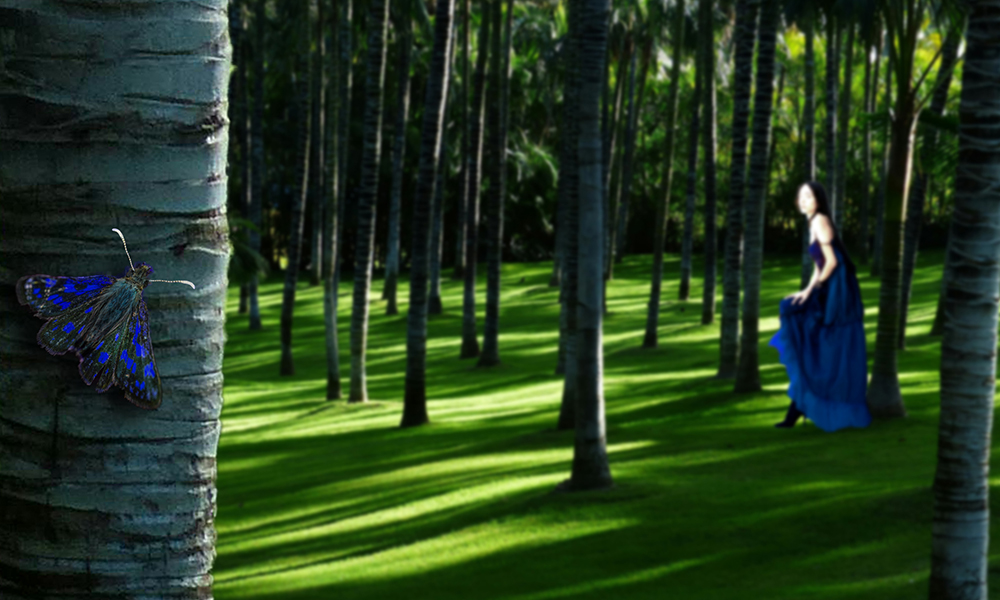
I got up to inspect his new favorite, splayed open on the hotel desk, under a bulb-shaped glass. The curtains were drawn to shield it from sunlight. I imagined destroying it, tearing its wings and crushing its abdomen and legs. I lifted the protective glass and traced the intricate edge of its wings with one fingertip. Reluctantly, I admired the black scales, the ribbon of cream adorning the upper wing, the dots of blue on the bottom wings.
My finger froze.
I stared at the wings. I felt a kick, the sharp heel of my heartbeat. I knew what I was seeing. Cayetana’s dress. An insect replica of Cayetana’s dress.
My neck tingled. I sensed an alien presence biding its time, waiting to approach. I stared hard at the room, at Frank expelling air. My heart clanging, I moved furtively, as if under observation. I didn’t wake Frank, instead I dressed hurriedly, pocketed whatever bills lay on the table, and slipped out.
The late afternoon was drenched in sunlight, a last show of summer. I walked down the traffic-jammed avenue and entered the park. There were very few people at this hour, on a meadow nearby shrieking children raced each other. I averted my eyes and headed in the opposite direction.
I walked through the park far longer than I intended, always toward what I had assumed was the other side of town, wading in deeper instead. This section had something reclusive to it, the green bitter, the light ashen. I hadn’t spoken to anyone in my family in almost two decades, yet I felt they were slowly gathering in the luminous air around me, cheering me on, my dead grandmother, my mother, my uncle.
I walked to a stone bridge over a brook and paused to orient myself, but I had no map and there was no one in sight. Until the young girl appeared, at the other end of the stone bridge. She was standing still, glaring at me, as if willing me to comply with something.
“Hello?”
The girl didn’t move. I looked around for an adult in charge, but the paths were empty, the meadow far behind me. I looked back at the girl. She lowered her head and charged. In a second she was on me, kicking my shin. I was too stunned to react. Her dainty leather shoe hit my leg, once, twice, before the pain registered and I shouted at her, “Stop! Stop!”
I grabbed her arms, but she kept kicking with her skinny legs, panting like a small dog. Kick back, urged a voice in my head, and I raised my foot to take aim. The girl let out a growl, tore free from my grip and ran off.
The park slipped back into silence.
I stumbled on. With every step the silence grew vaster, more lifeless. I turned a bend and emerged on a broad promenade, lined by towering, interlocking Elms. Like tentacles, I thought, looking at their twisting branches. Frank had once compared the branches of a similar tree to dendrites twisting from a cell body. I paused, peering into the tunnel of trees. A shape hovered at the far end, a mere blot in the distance. A figure. It made a sound that seemed to emanate from right next to me, it was clearing its throat. And then I could hear it speak.
“You have to want rightly.” The words floated like heads without bodies. “There’s nothing difficult in simply wanting. But to want rightly is a gift. Do you know what you want?”
I didn’t answer.
“Well?” The voice prodded.
A faint prick in my right eye.
“Cayetana?” I called out, feeling foolish and scared.
The thing at the other end came toward me, sharpening, assembling itself mid-air out of a million particles. A woman. She was naked. Her smooth tail slapped the ground in a phlegmatic dance. Halfway down the promenade, she stopped, gathered her tail, and sat upon a bench.
“Come,” she called out tenderly.
I went. I sat on the far edge of the bench. Nothing happened. Cayetana crossed her sculpted legs and gazed dreamily at the canopy of leaves. She had no nails, no pubis, no nipples, her skin a pale suit without zipper or buttons. I raised my eyes and discovered we had an audience. On the opposite bench sat my mother, my grandmother, and my uncle, nodding encouragement. I took a quick breath.
“Yes?” Cayetana began.
“Yes what?” The shrillness of my voice was startling.
“You came to see me, no?”
“Yes," I admitted after a moment.
“You’ve thought about my offer?”
“What offer?” I asked quickly, then corrected myself: “Is this a deal?”
Cayetana smiled. Her tail uncurled, lovingly flicked up dust. “If you like.”
I gripped the bench with both hands.
“You want my… soul?” I couldn’t think of a better word.
There was a clucking at my side. Faint cackles from the other bench.
“Ah, no, thank you. You can keep your soul.”
“What then?”
A polite pause.
“Not what,” she gently instructed. “Whose.”
There was a delay before I understood. I tried to imagine what Frank would have done. Nonsense, he would have said and walked away. I stole a glance at my gnarled family. They sat proud and eager, a wool-clad black triptych, itching for a funeral. I thought of Frank’s breathing as he slept in our hotel room. How repulsed he would be to see me here. How astonished he would be to die.
It was dark when I returned to the hotel.
You were waiting in the lobby, unscarred. My heart jumped at the sight of you.
You were intact.
You were alive.
You were talking to an elderly couple, their expressions soft with adoration for you. My mother. My uncle.
“You’re here!” I cried, cutting in almost petulantly. You looked at me, baffled, and said I must be mistaking you for someone else.
“No, no!” I said, clutching your arms, “you are Cosimo, you are my son!”
The shrillness of my voice again, like a stranger’s.
You pulled away, annoyed, brushed off my touch from your shirt like dirt.
“What is she saying, dear?” my mother and uncle asked, eagerly clustering around you. Dressed in black, as if in mourning.
You looked back at me then, a familiar air on your face.
“Nonsense,” you said.
Thanks for reading - but we’d love feedback! Let us know what you think of The Negotiation at Bluesky.